Radios and Antennas in the Truck
What’s in Gary’s truck, what each piece is for, and how he decides which antenna goes up.
A mobile station has to earn every bit of space it takes. Every radio and antenna in Gary’s truck has a job. This page goes through his setup by role: what each piece does, why it’s worth carrying, and the general thinking you can apply to your own vehicle.
The models named here are Gary’s own gear, listed so you can see what his setup is. They aren’t endorsements, and other radios do the same jobs.
The console
The radios live in a console that came out of the 2021 rewire that built the console. Building it into the truck, rather than balancing radios on the seat, gives everything a fixed home, a planned power feed and room to work.
The radio console
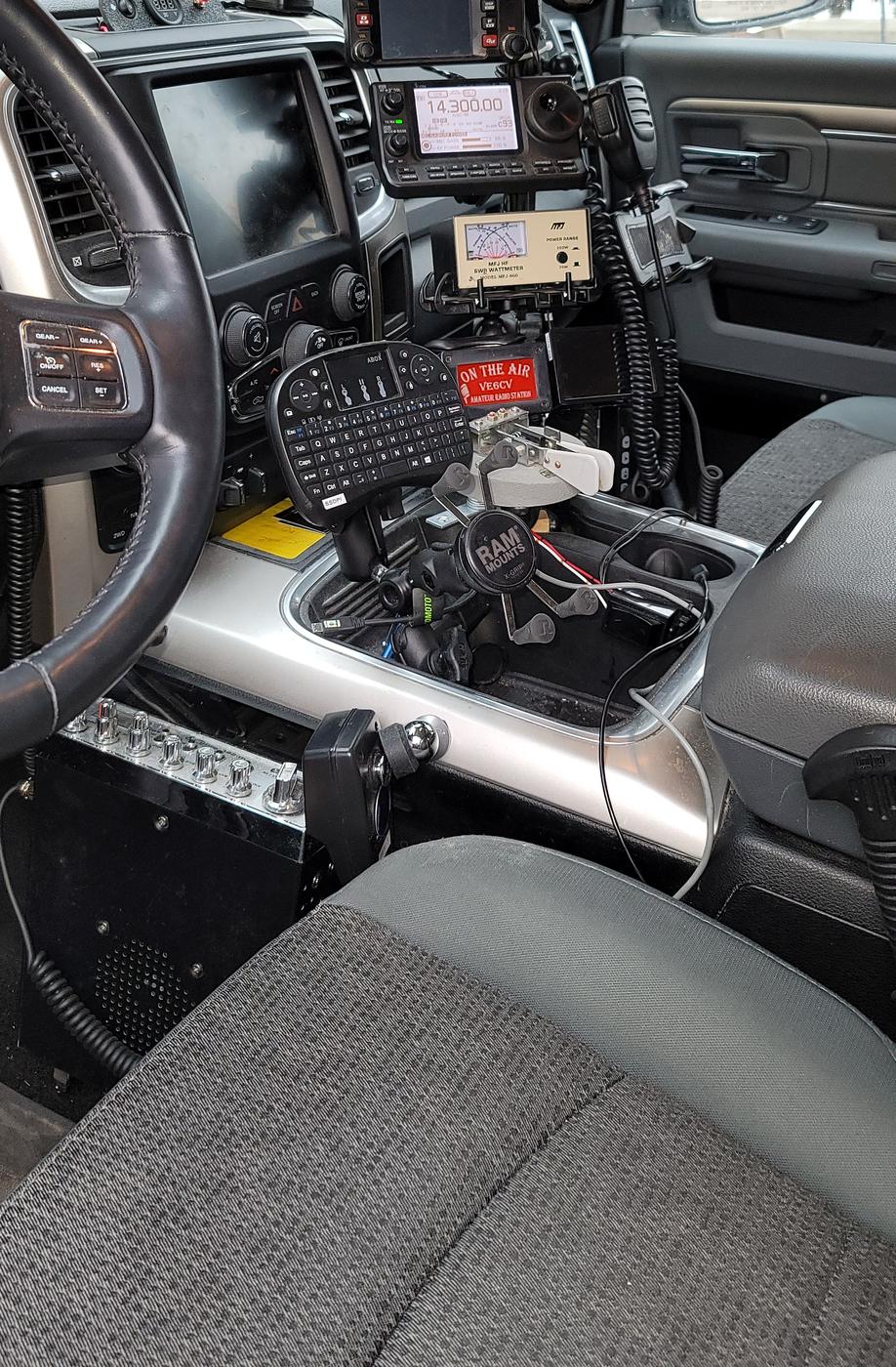
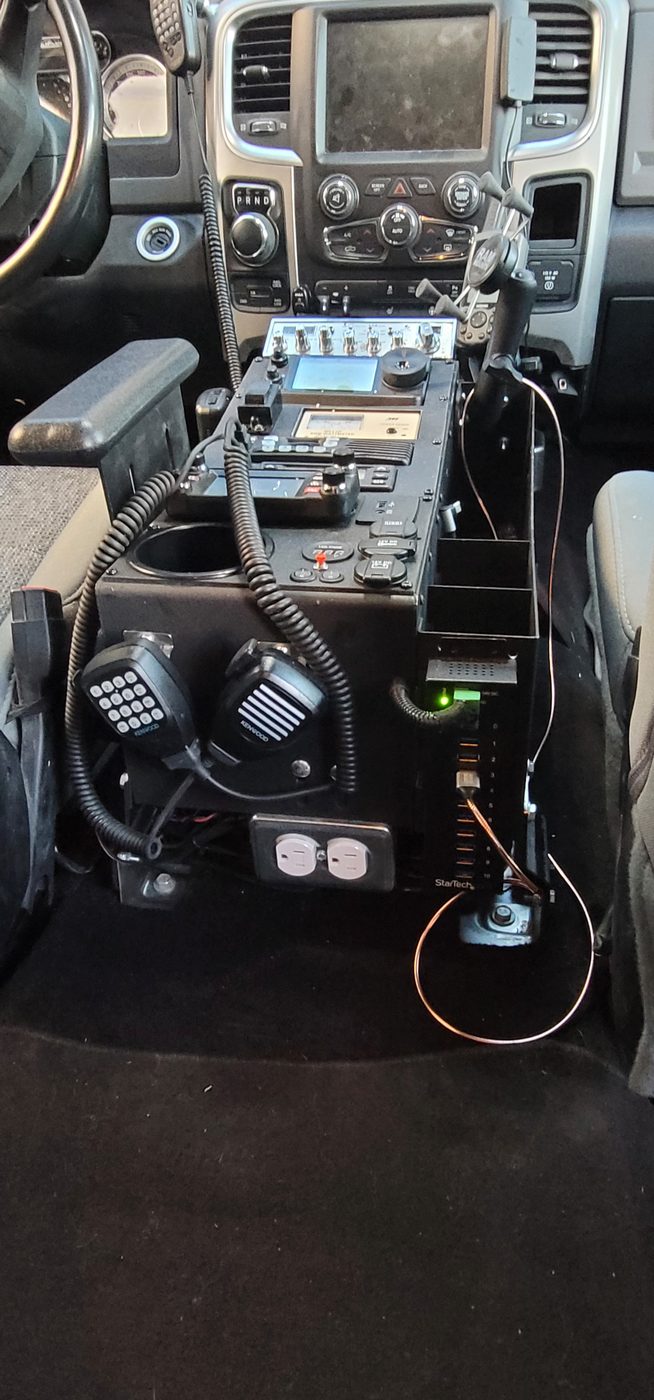
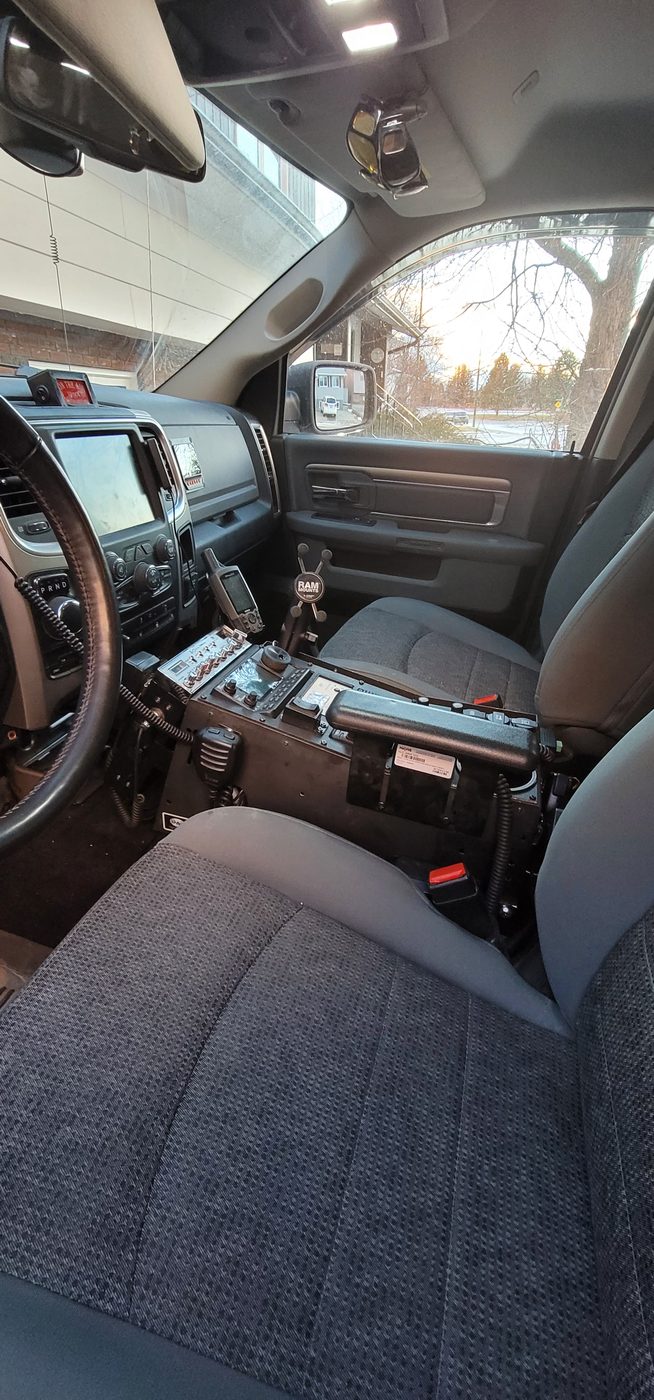
HF: the long-distance radios
| Gary’s setup | Role | Why it earns its spot |
|---|---|---|
| Yaesu FT-710 Field | HF transceiver, powered from external 13.8 V DC | A full HF radio that runs on 13.8 V DC is a natural fit for a vehicle or a battery-powered camp. No household power needed. |
| Icom IC-7100 | Mobile and portable radio covering HF, VHF and UHF, with a detachable control head | One box covers a very wide range of bands, and the head can sit where the operator is while the radio body stays out of the way. |
The remote control head
The IC-7100’s control head comes off the radio. In the field, Gary uses an extra remote head on a 15-foot (about 4.6 m) insulated CAT-5 cable. The head sits at the table or beside his chair, and the radio body stays in the truck.
The radio stays put
The radio body keeps its power and coax connections in the truck, so there are no heavy cables running out to the table.
The operator is comfortable
You can run a net or a long session from a chair in the shade instead of sitting in the cab.
Less to set up
The radio’s connections are made in the truck, so setting up the operating position means running out one control cable.
Route any cable that crosses a campsite where nobody will trip over it, and keep it out of doorways and the path to the truck.
The auto tuner
Gary’s field setup includes an auto tuner. A tuner matches the antenna system to the radio so the radio sees a load it’s happy to transmit into. It doesn’t make a poor antenna radiate better. Losses in the antenna and the coax stay where they are. It’s what lets one antenna be used on several bands without the radio cutting back its power.
VHF, UHF and DMR: the local radios
| Gary’s setup | Role | Why it earns its spot |
|---|---|---|
| Yaesu FTM-400 | VHF/UHF mobile, cross-band repeat capable | Local repeaters and simplex, and it can relay a handheld through the truck. |
| Icom IC-2730 | VHF/UHF mobile, cross-band repeat capable | A second local radio, so one can sit on a repeater while the other monitors or relays. |
| Icom dual-band handheld | Personal VHF/UHF radio | Lets the operator walk away from the truck and stay in touch. |
| Arrow dual-band handheld Yagi | Small directional antenna held by hand | Points your signal (and your listening) in one direction, which helps reach a distant station or find where a signal is coming from. |
| RFinder B1+ | RoIP (radio over internet protocol) and DMR digital voice | Covers the digital side of the station, including links carried over the internet. |
Cross-band repeat in plain words
A radio set for cross-band repeat listens on one band and retransmits what it hears on the other. Parked at camp, the mobile radio in the truck can relay a small handheld to a repeater the handheld could never reach on its own. The truck’s bigger antenna and power supply do the heavy lifting. Your mobile radio’s manual explains how to set it up.
HF antennas: on the move, parked or camped
Gary’s HF antenna kit for the truck:
Buckmaster OCF dipole
An off-centre-fed dipole: a long wire fed away from its middle so it can work on several bands. It needs supports at both ends, such as trees or masts, so it’s an antenna for when you’ve stopped.
Chameleon Tactical Delta Loop
A delta loop is a closed loop of wire in a triangle shape. This one is a portable design, an option when there isn’t room or support to string out a long wire.
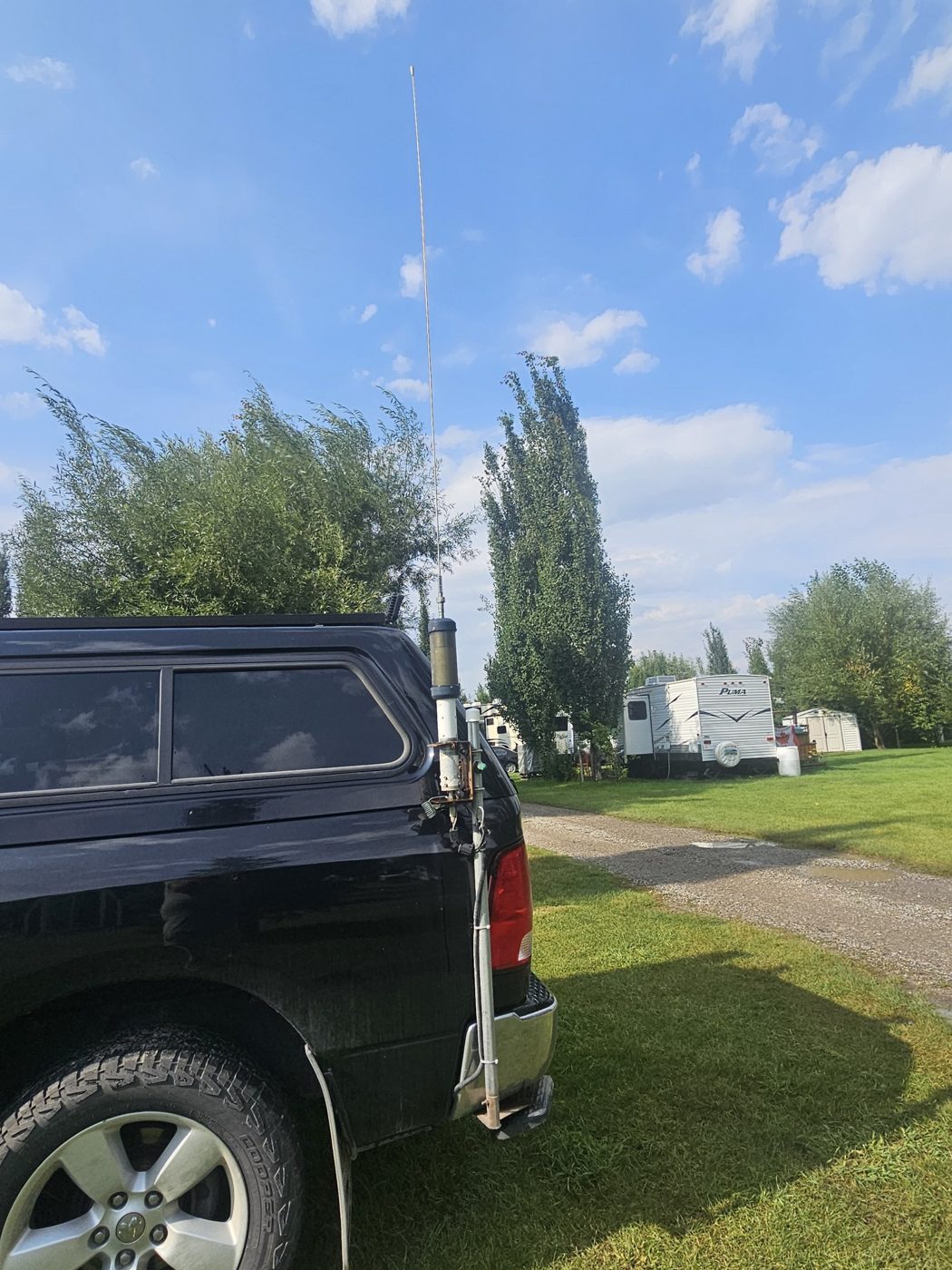
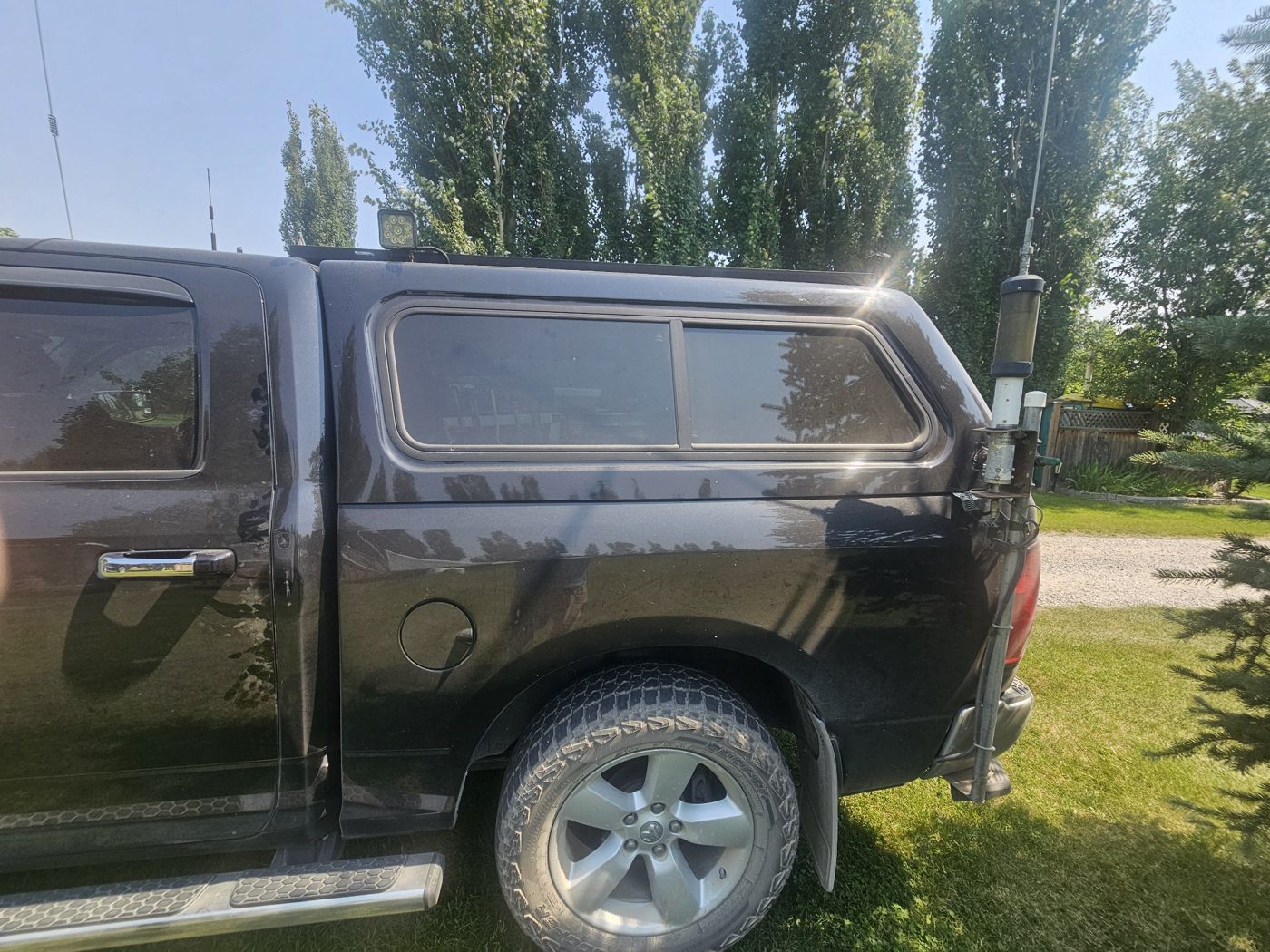
16-foot steel whip with radials
A tall vertical. The radials are wires spread out from the base that give the whip the ground system a vertical needs to work against.
How to think about it
Rolling
Anything on a moving vehicle has to be mounted solidly, survive wind and bumps, and clear garage doors, drive-throughs, trees and power lines. That limits its size, and short antennas are a compromise, especially on the lower bands.
Parked or camped
Once you’ve stopped you can put up far more wire, higher and in the clear. A full-size dipole or loop will usually outperform anything you can drive with. Give yourself time to set up properly.
Look up before you put anything up. Before raising a mast, throwing a line into a tree or standing up a tall whip, check for overhead power lines. Keep the antenna and everything attached to it well clear if it were to fall. Take antennas down or disconnect them when a thunderstorm is coming.
More on antenna choices: portable antennas, wire antennas and antennas.
Antennas
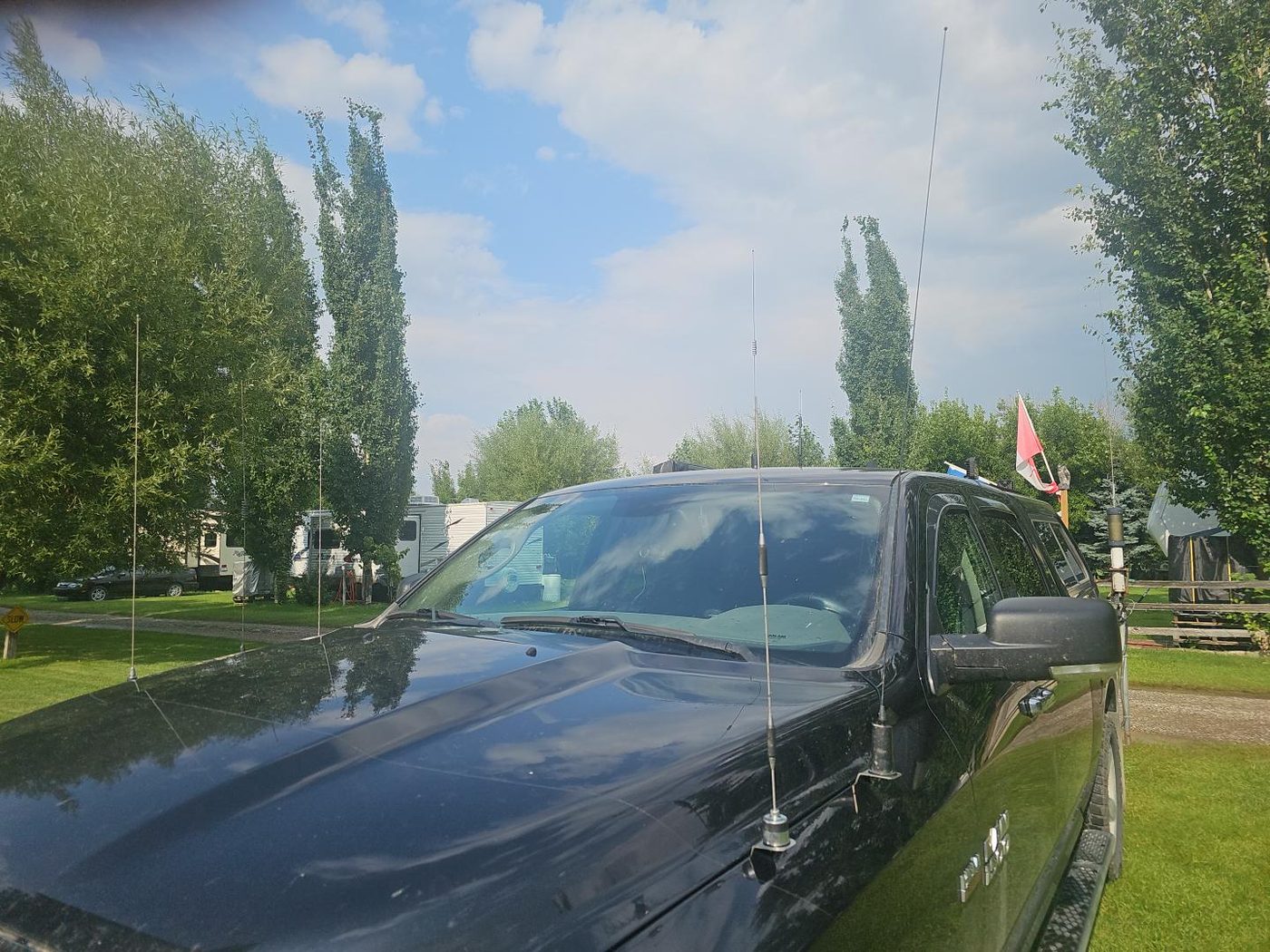
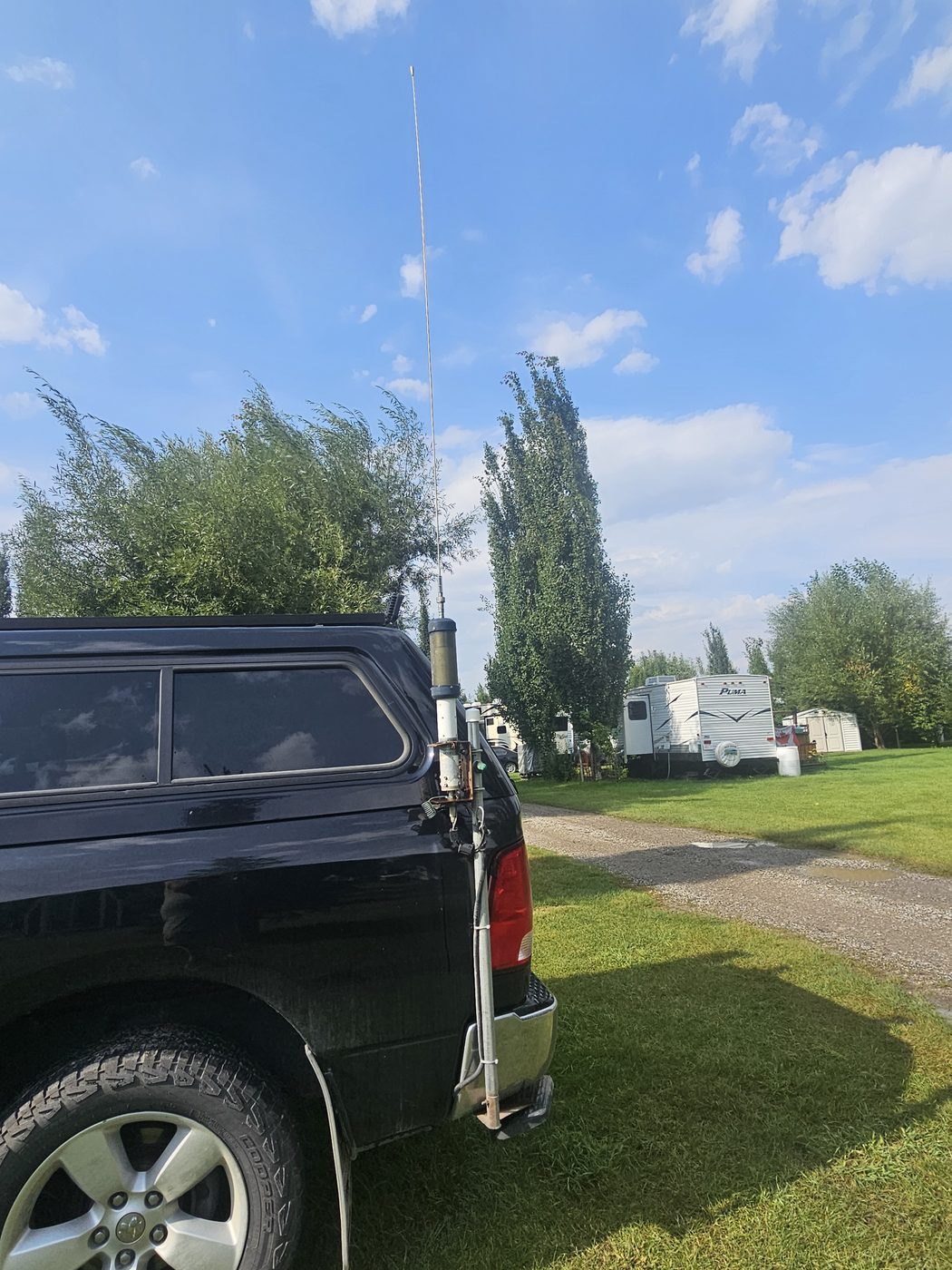
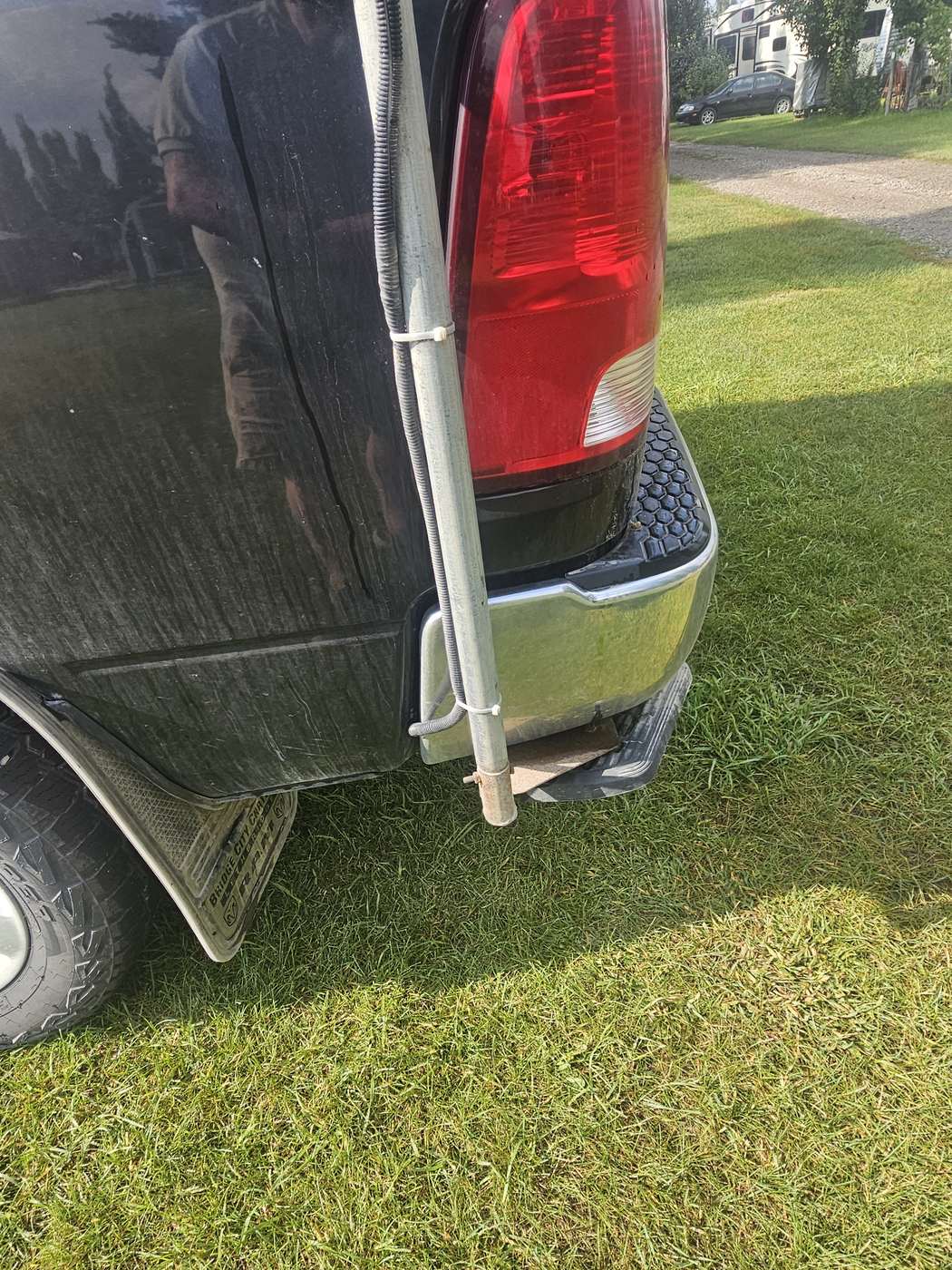
The HF antenna on the truck
Tuning and testing
Gary carries three test instruments: a RigExpert AA-235 antenna analyzer, a NanoVNA and a TinySA spectrum analyzer. You don’t need all three to start, but each answers a different question.
| Gary’s setup | The question it answers |
|---|---|
| RigExpert AA-235 antenna analyzer | Where is this antenna resonant, and what is the SWR across the band? Sweep it before you transmit, so you’re adjusting with facts instead of guesses. |
| NanoVNA | A small vector network analyzer. It measures SWR and impedance too, and it’s handy for checking coax, connectors and tuning adjustments. |
| TinySA spectrum analyzer | What’s actually on the air or on the wire? It helps you track down noise and check that a transmitter is clean. |
A simple routine at a new site
- Put the antenna up where it will stay, in its final position.
- Sweep it with the analyzer across the bands you plan to use and note where the SWR is lowest.
- Adjust, then sweep again. Change one thing at a time.
- Check the coax if the readings look odd. A bad connector fools everyone.
- Listen for noise before blaming the band. Switch off the inverter or charger for a moment and see if the noise goes away.
- Then let the tuner do the rest and get on the air.
See what SWR really costs you with the SWR and Power tool. If you’re chasing noise, read RFI and neighbours.
RF exposure basics
Canada’s limits for human exposure to radio-frequency energy are set out in Health Canada’s Safety Code 6, and ISED’s regulatory standards require compliance with them. The Canadian amateur exam teaches that no transmitter is exempt, handhelds included. It also teaches that exposure limits are lowest from 48 to 300 MHz, where the human body absorbs RF energy most.
- Distance is your friend. Exposure drops quickly as you move away from an antenna. Mount and place antennas where people won’t be standing right beside them.
- Watch who’s near the antenna. Don’t transmit while someone is touching it, working on it or standing next to it. That includes kids around the truck at camp.
- Handhelds and handheld beams. Keep the antenna away from your face and eyes, and point a handheld Yagi away from people when you transmit.
- Less power is often enough. Use only the power you need for the contact.
Driving: what Alberta’s rules say
Alberta’s distracted-driving rules apply to you. Alberta’s distracted driving page lists using two-way or hand-held radios as allowed when a driver must stay in contact with an employer, such as when escorting oversized vehicles, and during search, rescue and emergency management. The penalty for distracted driving is a $390 fine and 3 demerit points.
Licensed amateurs. Radio Amateurs of Canada reports that section 3(1) of Alberta’s Distracted Driving Regulation lets a person who holds a radio operator certificate issued under the federal Radiocommunication Act drive “while holding, viewing or manipulating a 2-way radio communication device.” The alberta.ca page itself doesn’t mention amateurs, so read the current Distracted Driving Regulation before relying on it.
What it doesn’t cover. The exemption RAC quotes is for a two-way radio. It says nothing about the phone, tablet or laptop you use for FT8, logging or maps, and Alberta’s rules restrict those separately. Alberta’s Traffic Safety Act also has a general ban on driving while doing something that distracts you from driving.
Our rule of thumb: keep it to short, simple contacts while rolling. Tuning, logging, FT8 and anything else that needs your eyes or both hands waits until you’ve pulled over somewhere safe.
Show us your setup. Gary runs Mobile HF Ham Radio Operators, a private Facebook group of about 2,400 members. Join and share photos of your own radios, consoles and antennas.
Sources
- Gary’s radios, antennas, remote head, tuner, test gear and the 2021 console rewire: Gary Wheeler, VE6CV.
- Alberta’s two-way radio situations and the $390 fine with 3 demerits: Government of Alberta, Distracted driving.
- Section 3(1) of the Distracted Driving Regulation (radio operator certificate holders): Radio Amateurs of Canada, Distracted Driving Regulations in Canada (updated March 2024). The regulation itself: Alberta Regulation 113/2011.
- The Traffic Safety Act‘s general distraction ban (s. 115.4): ABlawg, Distracted Driving and the Traffic Safety Act (2019).
- Safety Code 6 and ISED’s role: Health Canada, Understanding Safety Code 6.
- No transmitters exempt, and the lowest limits at 48 to 300 MHz: Canadian Basic question bank, section B-001-024.